 AI-powered, Human-reviewed.





Why Subscription Apps That Worked at Launch Stop Working at Scale
Every subscription app is built for a specific band of volume and complexity. At launch, with a few hundred subscribers and one flat monthly plan, almost any app feels fine. The gap between “works” and “breaks” isn’t visible yet because you haven’t hit the ceiling.
Then the business grows. You add a second SKU, a quarterly option, a bundle, and an international customer base. Subscriber count crosses a few thousand. And suddenly the same app that felt effortless starts generating support tickets, slow pages, and revenue leakage you can’t explain.
This isn’t really an app-quality problem. It’s a fit problem. The app was scoped for a use case you’ve since outgrown, and most merchants don’t notice until something breaks in production, a checkout that hangs at 2am during a flash sale or a spike in failed payments nobody caught for three weeks.
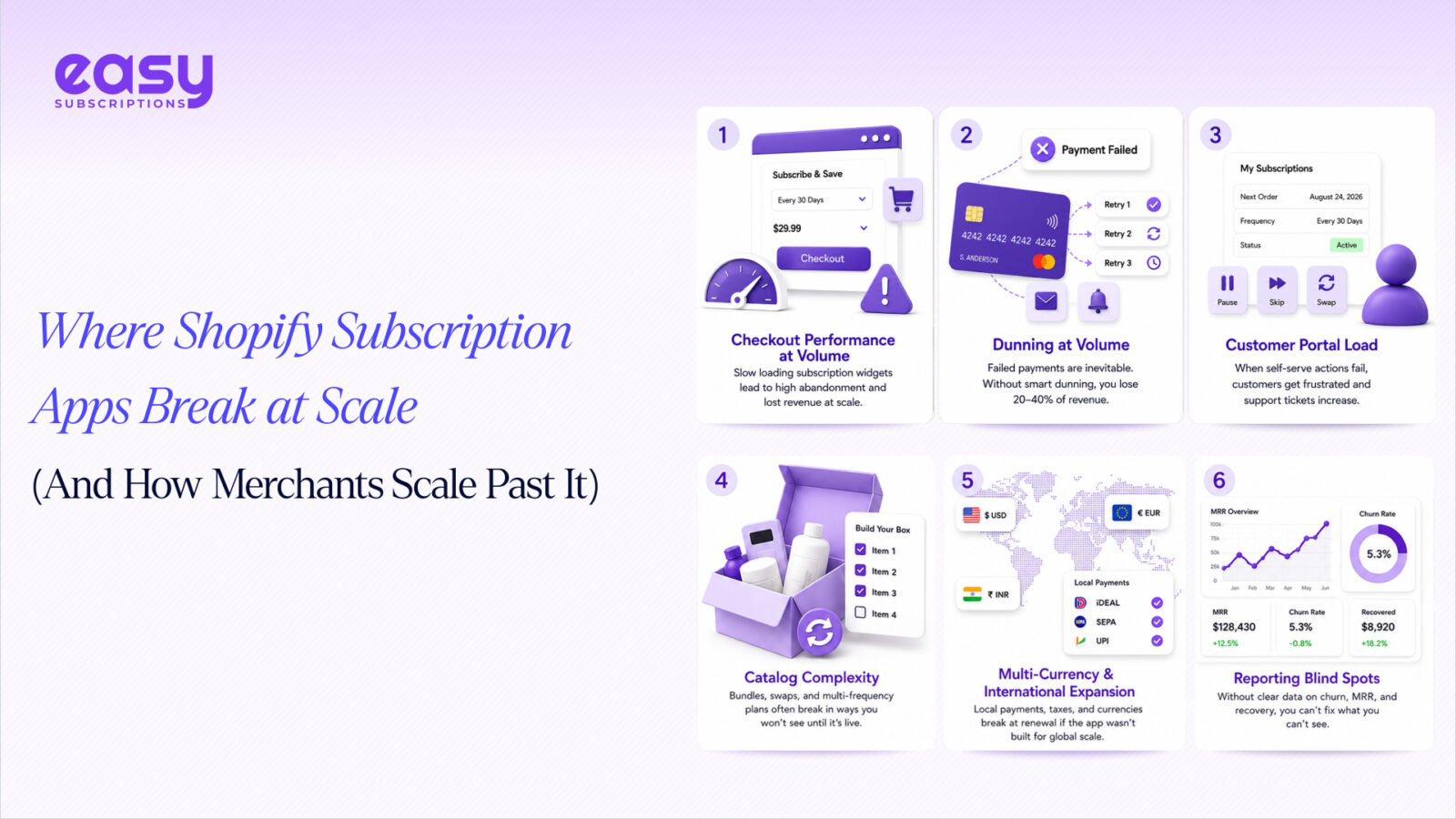
The 6 Places Subscription Apps Break Down
1. Check Out Performance at Volume
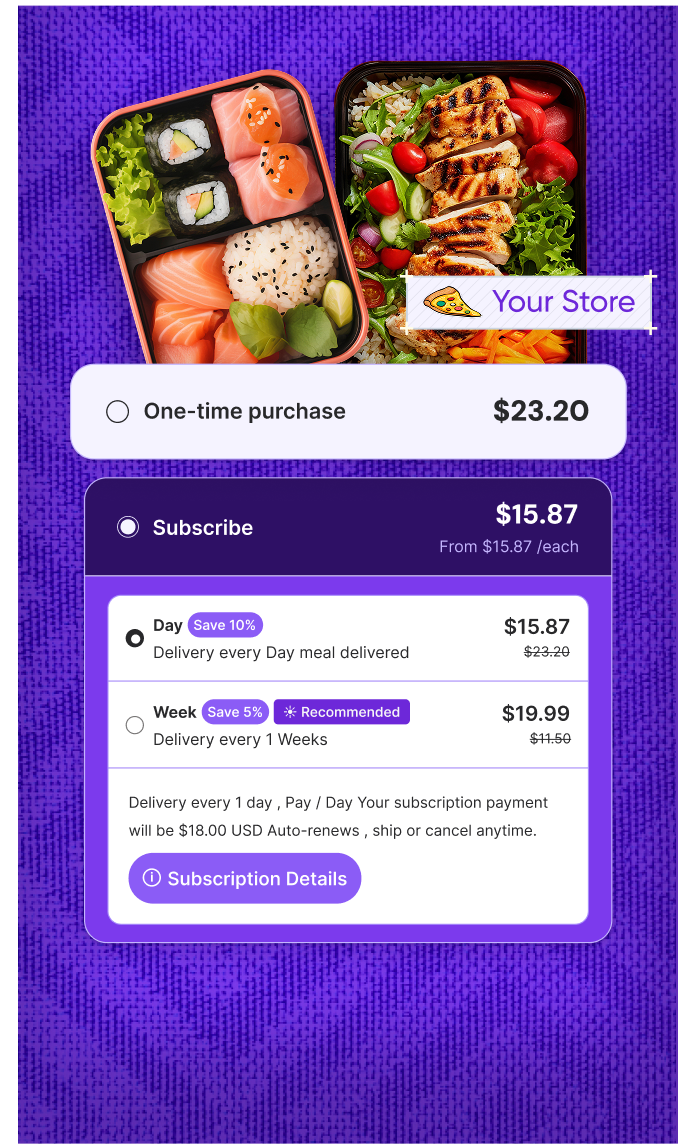
Subscription selectors, frequency dropdowns, plan toggles, and discount logic, add JavaScript weight to every product and cart page. At low traffic, that’s invisible. At scale, it isn’t.
The numbers here are blunt. Checkout pages that take more than 3 seconds to load see roughly 40% of shoppers abandon on the spot, and a 2-second delay alone can push abandonment past 50%. Every additional second of load time costs an estimated 7% in conversions. Mobile shoppers are even less patient, abandonment on mobile checkout can hit 85% past a 3-second threshold.
Now stack a subscription widget with live pricing calculations, inventory checks across a growing SKU catalog, and third-party scripts on top of that. This is exactly where subscription app for growing brands conversations start, because the app that rendered instantly with 20 products chokes at 200.
2. Dunning at Volume
Dunning is the process of retrying and recovering failed recurring payments; expired cards, insufficient funds, and soft declines. With 300 subscribers, failed payments have little impact. At 5,000 subscribers, they become a measurable hit to your bottom line.
Industry benchmarks show that 5–10% of recurring payment attempts fail each month. Left alone, only 25–35% of those self-resolve. Basic retry logic gets you to 40–50% recovery. Optimized dunning, smart retry timing, card updater, and multi-channel reminders, recovers 60–75%, and the best setups clear 80%+.
Involuntary churn from failed payments alone accounts for 20–40% of total churn in subscription businesses, and roughly 9% of MRR is lost to it annually if nobody’s watching. At low subscriber counts, a few failed charges a week is a rounding error. At scale, it’s thousands of dollars a month quietly walking out the door.
3. Customer Portal Load
Self-serve pause, skip, and swap features are what keep subscribers off your support queue. When they work. When they don’t, every failed self-serve action becomes a support ticket, and support tickets don’t scale linearly with subscriber count; they scale worse.
A customer portal built for a few hundred users on a single plan type often wasn’t built to handle concurrent sessions, complex swap logic across dozens of SKUs, or real-time inventory checks during a skip. The result: customers can’t complete the action they came to do, get frustrated, and either churn or email support. Either way, the app that was supposed to reduce your workload just added to it.
4. Catalog Complexity
Simple, single-SKU subscriptions are the easiest subscription model for any app to support. Bundles, build a box, and multi-frequency plans are a different engineering problem entirely, swapping items inside a box, prorating price changes, and letting a customer mix a monthly item with a quarterly one in the same cart.
Many apps that market themselves as full subscription platforms were actually architected around the simple case first, with bundle logic bolted on later. That shows up as:
- Bundle contents that can’t be edited after the first order
- Pricing that doesn’t recalculate correctly on swaps
- Multi-frequency plans that silently break at renewal
If your roadmap includes build-a-box or curated bundles, this is one of the fastest ways to hit Shopify subscription app limitations you didn’t know existed until you tried to launch the feature.
5. Multi-Currency and International Expansion
Apps built and tested against a single-market checkout, USD only, one tax regime, one set of payment gateways tend to fail quietly when merchants expand internationally. Symptoms include:
- Prices displayed in the wrong currency at renewal, not just at first checkout
- Local payment methods (iDEAL, SEPA, UPI) not supported for recurring billing
- Tax and duty miscalculations on subsequent charges after the first order
None of this is exotic, it’s table stakes for global commerce. But it’s exactly the kind of thing that only surfaces once you actually start shipping abroad, by which point you’ve usually already onboarded international subscribers on the broken flow.
6. Reporting Blind Spots
Once the subscriber count crosses a meaningful threshold, often a few thousand active subscriptions, you need to see MRR trends, churn by cohort, and failed-payment recovery rates to run the business. Not export a CSV and build it in a spreadsheet every month. See it.
Average monthly churn in subscription e-commerce sits around 5.3% overall, with best-in-class brands under 3% and subscription box models running 8–15%. Without cohort-level visibility, you can’t tell whether your churn is coming from a bad onboarding flow, a pricing change, or a dunning gap. You’re diagnosing blindly. This is the quietest breaking point on this list, and often the most expensive, because it delays every other fix.
How to Know You’ve Outgrown Your Current Subscription App
Answer yes or no. Three or more “yes” answers is a strong signal you’re past your app’s comfortable ceiling.
| # | Question | Yes | No |
| 1 | Has your subscription checkout become noticeably slower as your product catalog or traffic has grown? | ☐ | ☐ |
| 2 | Do you have no clear, automated view of failed-payment recovery rates? | ☐ | ☐ |
| 3 | Are pause, skip, or swap requests a regular part of your support volume? | ☐ | ☐ |
| 4 | Have you had to delay or simplify a bundle or Build-a-Box launch because your app couldn’t support it? | ☐ | ☐ |
| 5 | Are you selling internationally with a checkout that wasn’t built for multi-currency from the start? | ☐ | ☐ |
| 6 | Can you view your MRR, churn rate, and cohort retention without exporting a spreadsheet? | ☐ | ☐ |
| 7 | Has a developer told you a feature request isn’t possible because of your app’s architecture? | ☐ | ☐ |
| 8 | Has subscriber churn increased without a clear explanation in the last two quarters? | ☐ | ☐ |
If you answered yes to questions 1, 2, and 6, you’re likely dealing with all three of the most expensive breaking points at once: checkout drag, silent revenue loss from dunning, and no visibility to catch either.
What to Evaluate When Migrating to a New App
Migration fear is usually bigger than migration reality. Merchants delay switching for months, sometimes years, assuming it’ll mean weeks of downtime and angry subscribers. In practice, most well-scoped subscription migrations run on a 14–21-day timeline from decision to first billing cycle on the new platform, and the actual data transfer, when payment tokens are ready, can complete in under two hours.
Before you commit to a new app, test these six things directly, not on a demo call, but in your own store:
- Checkout speed load the subscription widget on a product page with your real SKU count. Time it.
- Dunning automation asks what retry logic, card updater, and recovery channels are built in versus bolted on.
- Portal UX: Test the customer experience by pausing, skipping, and swapping a subscription yourself. Count how many clicks each action takes.
- Bundle / build-a-box support can a customer edit box contents after the first order, and does pricing recalculate correctly?
- Multi-currency support checks that pricing, tax, and local payment methods hold up at renewal, not just at first checkout.
- Reporting depth can you see MRR, churn by cohort, and recovery rate without exporting anything?
Before making your final decision, compare your shortlist against this checklist. For a deeper evaluation, explore our comparisons of Easy Subscriptions vs. Appstle and Easy Subscriptions vs. Recharge to see how the platforms differ in features, scalability, and migration support.
How Easy Subscriptions Solves These Breaking Points
Easy Subscriptions was built around the assumption that merchants grow not around a fixed subscriber ceiling. A few specifics that map directly to the breaking points above:
- Dunning management with configurable retry schedules and automated recovery flows, so failed payments get chased systematically instead of manually.
- Retention management tools that surface churn and cohort data without needing a separate BI stack, closing the reporting blind spot described above.
- A bundle builder designed for build-a-box and multi-frequency catalogs from the ground up, rather than added as an afterthought to a flat subscription model.
None of this replaces doing your own diligence, the self-assessment checklist above still applies. But if checkout drag, dunning gaps, or catalog limits are the reason you’re reading this, those are the exact three areas worth testing first.